Crosswind landing in a flight simulator: crab, sideslip and the de-crab
How to practise crosswind landings in a flight simulator: the crab, the wing-low sideslip and the de-crab in the flare, with the real wind of the day.
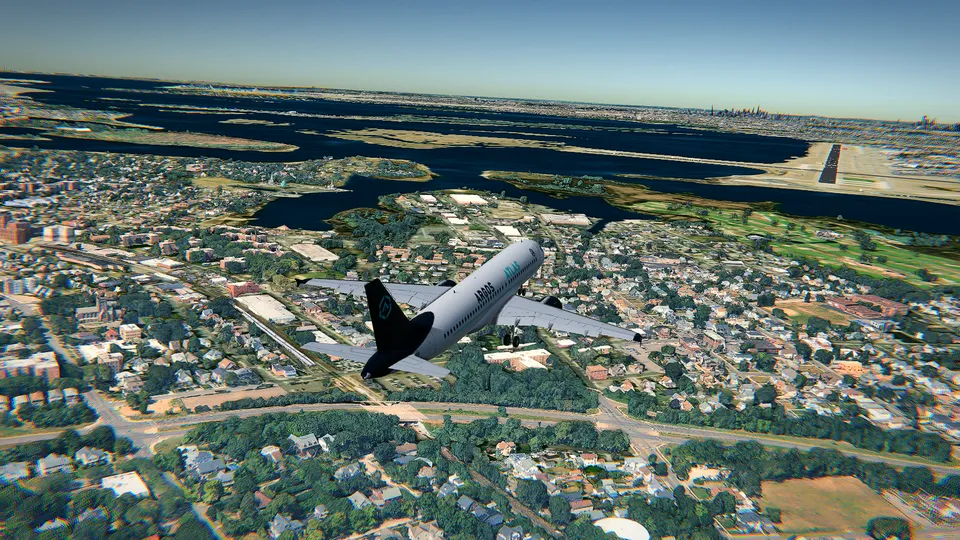
Runways point wherever there was room to build them, and the wind blows wherever it likes. Put those two facts together and you get the truth about landing: most of the landings you will ever fly have at least some wind across the runway.
It is also the part of landing that cannot be learned by reading about it. The aircraft arrives pointing somewhere other than where it is going, and your hands have to sort that out in the last two seconds. So here is how I practise crosswinds on purpose in Open Flight World, in the wind that is actually blowing outside today.
If still-air landings are not comfortable yet, start with how to land a Cessna 172: the speeds, the flaps and the flare. The keys below are all in the controls cheat sheet.
What a crosswind really does
An aeroplane flies through the air, not over the ground. If the air itself is moving sideways at 15 knots, an aircraft pointing exactly at the runway is being carried sideways at 15 knots while it flies. Nothing feels wrong in the cockpit: the slip indicator on the PFD is centred, the wings are level, the speed is right. Only the view out of the front gives it away, because the runway slides slowly off to one side.
To track the centreline you have to point the nose into the wind by a few degrees. That difference between where the nose points and where you are actually going is the drift, and the whole art of a crosswind landing is dealing with it at the instant the wheels touch, because wheels only roll the way they are pointing.
How much wind you get across the runway depends on the angle:
| Wind angle to the runway | Crosswind |
|---|---|
| 10° | about a sixth of it |
| 30° | half of it |
| 45° | about 0.7 of it |
| 60° | about 0.9 of it |
| 90° | all of it |
The 30 and 45 rows are worth memorising. A 20-knot wind 30° off the runway is a 10-knot crosswind, which is a pleasant exercise in a Cessna 172. The same 20 knots at 60° is about 17 knots across, beyond the 15 knots the Cessna 172S handbook gives as its maximum demonstrated crosswind component. That figure is not a legal limit, it is the strongest crosswind a test pilot landed it in, but treat it as a sensible ceiling.
The crab
Fly the approach with the nose offset into the wind, wings level, tracking the centreline. It is comfortable, it is accurate, and it is what airline crews fly almost all the way down.
Find the angle by trial. If the runway drifts to the right in your windshield, your track is left of it, so turn a few degrees right with ← and → and see whether the drift stops. Small changes only. When the runway stops moving sideways and simply grows, you have the angle.
The crab costs you nothing on the way down, but it leaves everything to do in the flare.
The sideslip, wing low
The other way is to cancel the drift with steady, deliberately unbalanced flight: bank slightly into the wind so the aircraft slips upwind at exactly the rate the wind pushes it downwind, and hold the nose straight along the runway with opposite rudder. The aircraft is then pointing where it is going, and it can touch down just as it is.
In Open Flight World this is kinder than you might expect, because the controls set a rate and then hold what you leave them at. A tap of ← or → gives you a few degrees of bank and it stays there; a nudge of , or . puts the nose back on the runway heading. You set the slip up rather than wrestling with it, and then you only adjust: more bank if you drift downwind, less if you start crossing the centreline into the wind.
Two things to keep in mind:
- The upwind wing goes down, so the rudder goes the other way. Wind from the left: left wing down, right rudder.
- A slip costs lift, so you sink a little faster. Expect to carry a touch more power with Shift.
Hold a wing-low slip all the way down final and your hands and feet learn the coordination, which is why instructors teach it that way. Gliders do it as a matter of course: the 18 m sailplane has one wheel on the centreline and very little wingtip clearance to spare.
The de-crab in the flare
This is the move worth a hundred attempts. Fly the approach crabbed, which is easy, and then, in the last couple of seconds:
- Power to idle with Ctrl and start the flare, raising the nose gently with ↓.
- Push the rudder towards the centreline, , or ., to swing the nose from your crab angle onto the runway heading.
- Drop the upwind wing slightly with ← or → at the same moment, because as soon as the nose is straight the aircraft starts drifting downwind again. That is the sideslip once more, held for two seconds instead of two miles.
- Let it touch on the upwind main wheel first, then the other one, then the nosewheel with ↑.
Timing is the whole thing. Too early and you slide down the runway in a slip, fighting to stay on the centreline. Too late and you touch down crabbed, which in a real aircraft puts a nasty sideways load through the gear. The rule I use: start the de-crab as the runway edges begin to spread out past the windshield, roughly a wingspan above the ground.
Making the wind do what you want
The live weather is what turns this from a drill into real practice. Choose it and you fly in the wind that is actually blowing at the airport you picked, with the sun where it really is.
Open Flight World lines that wind up with the runway you start from, so your takeoff is into the wind. The crosswind comes from landing on a runway that does not face it: take off, then fly to an airport whose runway points elsewhere. The angle between the two runway headings is the angle the wind meets you at, and the strength is whatever the day has decided.
So you can order the lesson you want:
- Headings 30° apart: half the wind across the runway. A good first session.
- 50° to 60° apart: most of it. A real workout, and the day you find out what the 15-knot figure means.
- A gale in November: all the practice you could want. A calm morning: not much, so look for a windier part of the world.
After the wheels are down
A crosswind landing is not over at the touchdown. The wind is still blowing, and now you are steering a weather vane with brakes.
- Keep a little aileron into the wind with ← or →, so the upwind wheel stays loaded.
- Get the nosewheel down with ↑ and hold the centreline with , and ..
- Brake with Space, gently.
Then go and look at what you did: V replays the last minute, and the chase camera with C shows the drift and the crab from outside far more clearly than the cockpit ever will.
What usually goes wrong
- Too fast. Extra speed means a long float, and a float gives the wind more time to push you towards the edge.
- Full flaps in a strong wind. The real technique is the least flap that will do the job: in the Cessna, 20° instead of 30°, flown a few knots faster, and never above 85 knots with the last notches.
- Letting the drift build. Fix it early and small. A crosswind approach is a long series of tiny corrections.
- De-crabbing with rudder alone. The nose comes straight and the aircraft immediately slides downwind. The wing has to come down with it.
- Carrying on regardless. If you are not lined up, go around: full power with Shift or 9, a notch of flaps in with ], and come back for another one.
Then try it in something else
- The Cirrus SR22 arrives faster, so the drift angle is smaller and the timing tighter.
- The Pilatus PC-12 and the ATR 72-600 have long wings and a lot of side area: they weathervane, and the rollout needs attention.
- The Airbus A320neo and the Boeing 787-9 are flown crabbed and de-crabbed in the flare. Judging it from a cockpit ten metres above the wheels is a different problem entirely.
- The F-16 lands fast and rolls quickly. Small inputs, or none.
The airports where the wind matters most are the ones with water, hills and one awkward runway, and there is a tour of them in the best airports to fly in a simulator. If you want to know where the wind and the traffic come from in the first place, that is in real-time weather and live air traffic.
Frequently asked questions
What is a crosswind landing?
It is a landing where the wind blows across the runway instead of along it. The aircraft drifts sideways, so you have to point the nose into the wind to track the centreline and then get the aircraft straight again before the wheels touch, because wheels only roll the way they point.
Crab or sideslip: which should I use?
Both work. The crab (nose into wind, wings level) is the comfortable way to fly the approach, and most airline crews fly it almost all the way down, removing it in the flare. The wing-low sideslip (upwind wing down, opposite rudder) lines the aircraft up early and lets you touch down exactly as you are, which is why instructors use it for teaching.
What is the maximum crosswind for a Cessna 172?
The Cessna 172S handbook gives 15 knots as its maximum demonstrated crosswind component. That is not a legal limit, it is the strongest crosswind a test pilot landed it in, but it is a very sensible ceiling. Remember the angle matters: a 20-knot wind 30 degrees off the runway is only 10 knots across it.
How do I get a crosswind in Open Flight World?
Fly with the live weather, which gives you the wind that is actually blowing at the airport you choose. The wind is lined up with the runway you start from, so your takeoff is into it; the crosswind comes from landing on a runway that points somewhere else, so pick a departure and an arrival whose runway headings are 30 to 60 degrees apart.
Is it free to practise this?
The Cessna 172 at London City (EGLC) is free, in photorealistic 3D, with no account, no ads and no time limit, which is enough to drill the flare, the de-crab and the rollout. Flying to another airport means unlocking it, or All Access, on the pricing page.